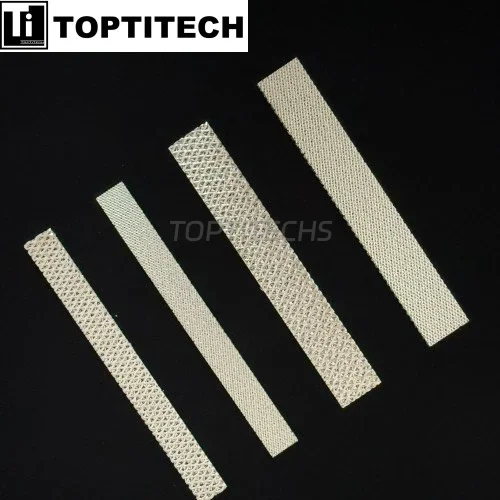
Platinized Titanium Expanded Mesh for Electrochlorination
Platinized titanium expanded mesh for industrial electrochlorination. Stable platinum coating, high chlorine efficiency, long service life.
Products Specifications
| Material | GR1 Tiatnium |
| Size | 100*100*1.0mm |
| Mesh Size | 3*6mm |
| Coating | Platinum |
| Coating thickness | 1 micron |
Overview of Platinized Titanium Expanded Mesh
The platinized titanium expanded mesh is a premium electrode substrate engineered for industrial electrochlorination systems where catalytic efficiency, dimensional stability, and long-term reliability are paramount. This product combines the exceptional mechanical properties of expanded titanium mesh with a high-activity platinum coating, delivering an anode material that outperforms conventional electrode solutions in hypochlorite generation, seawater electrolysis, and chlorine production applications.
Expanded mesh geometry provides several inherent advantages over perforated sheet or woven wire alternatives. The open diamond-pattern structure maximizes active surface area while minimizing hydraulic resistance, allowing electrolyte to flow freely through the electrode assembly with minimal pressure drop. This design characteristic is critical in high-throughput electrochlorination cells where uniform current distribution and efficient mass transport directly determine chlorine evolution efficiency. The platinized titanium expanded mesh achieves a balance of high geometric surface area, excellent electrical conductivity, and mechanical robustness that makes it the preferred choice for demanding electrochemical environments. Engineers specifying this material benefit from consistent performance across extended operating campaigns, reduced cell maintenance intervals, and lower energy consumption per kilogram of chlorine produced.
Manufacturing and Platinum Coating of Platinized Titanium Expanded Mesh
The manufacturing process of platinized titanium expanded mesh begins with the selection of high-purity Grade 1 or Grade 2 titanium sheet conforming to ASTM B265 specifications. The base titanium is processed through a precision expanding machine that simultaneously slits and stretches the sheet, forming the characteristic diamond-shaped apertures without generating material waste. This cold-working process preserves the substrate’s grain structure and mechanical integrity, resulting in a continuous mesh with uniform strand width, aperture dimensions, and flatness tolerances critical for subsequent coating adhesion.
The platinum coating is applied to the titanium expanded mesh through an advanced electrodeposition or thermal decomposition process, depending on the target platinum loading and application requirements. Prior to coating, the titanium substrate undergoes a rigorous surface preparation sequence including alkaline degreasing, acid etching to remove the native oxide layer, and intermediate rinsing in deionized water. This pretreatment protocol ensures maximum adhesion between the platinum layer and the titanium substrate, preventing delamination during extended electrolysis operation. The electrodeposition route delivers a dense, adherent platinum layer with controlled thickness ranging from 2 to 10 microns, while thermal decomposition methods produce a platinum-oxide composite coating optimized for oxygen and chlorine evolution reactions. Every platinized titanium expanded mesh batch undergoes post-coating inspection to verify coating uniformity, adhesion strength, and electrochemical activity before release.
Electrochlorination Applications of Platinized Titanium Expanded Mesh
The platinized titanium expanded mesh serves as the anode material of choice across a broad spectrum of electrochlorination applications, from large-scale seawater cooling water treatment at coastal power stations and LNG terminals to compact on-site hypochlorite generators for municipal water disinfection. In seawater electrochlorination, the platinum coating provides exceptional resistance to the aggressive chloride-rich electrolyte while maintaining low chlorine evolution overpotential, translating to reduced cell voltage and lower operating costs over the equipment lifecycle.
Marine ballast water treatment systems rely on platinized titanium expanded mesh anodes to generate sodium hypochlorite in situ, ensuring compliance with IMO D-2 discharge standards without the logistical burden of transporting and storing hazardous bulk chlorine chemicals. Swimming pool electrolyzers, industrial cooling tower biocidal treatment loops, and food processing sanitation systems similarly benefit from the consistent chlorine output and extended service intervals provided by platinum-coated titanium anodes. The expanded mesh geometry is particularly advantageous in these applications because it promotes efficient gas disengagement, preventing bubble accumulation on the electrode surface that would otherwise increase cell resistance and reduce faradaic efficiency. TOPTITECH supplies platinized titanium expanded mesh in sheet, roll, and cut-to-size formats configured for integration into both monopolar and bipolar electrolyzer architectures. For substrate options, see our titanium expanded mesh electrode substrate and browse the full Metal Mesh products range.
Catalytic Performance of Platinized Titanium Expanded Mesh
The catalytic performance of platinized titanium expanded mesh derives from the unique combination of platinum’s exceptional electrocatalytic properties and the three-dimensional flow-through geometry of expanded metal. Platinum exhibits the lowest chlorine evolution overpotential among commercially viable anode coatings, enabling efficient hypochlorite production at cell voltages typically 200 to 400 mV lower than uncoated titanium or graphite alternatives. This voltage reduction directly translates to energy savings of 10 to 20 percent per kilogram of equivalent chlorine generated, a significant operational cost advantage for continuously running electrochlorination plants.
Beyond initial catalytic activity, the platinized titanium expanded mesh demonstrates remarkable stability under prolonged polarization. Accelerated life testing conducted at current densities of 500 to 2,000 A/m² in simulated seawater confirms service lifetimes exceeding five years under normal operating conditions, with gradual platinum consumption rates typically below 1 mg per ampere-year. The expanded mesh structure contributes to this longevity by facilitating uniform current distribution across the entire electrode surface, eliminating localized high-current-density hot spots that accelerate coating wear in poorly designed electrode configurations. Periodic electrochemical diagnostic testing allows operators to monitor coating condition and schedule proactive anode replacement, maximizing system uptime while avoiding unplanned outages.
Comparison of Platinized Titanium Expanded Mesh with Uncoated Alternatives
When compared to uncoated titanium expanded mesh, the platinized titanium expanded mesh offers decisive performance advantages that justify its selection for critical electrochlorination duty. Uncoated titanium anodes rapidly form a passive titanium dioxide surface layer under anodic polarization in chloride-containing electrolytes, causing a sharp increase in cell voltage and a corresponding decline in chlorine current efficiency. What begins as acceptable performance degrades within hours or days, whereas platinum-coated mesh maintains stable operating potentials throughout its entire service life.
Mixed metal oxide coated titanium anodes represent an alternative to platinum coatings, particularly for oxygen evolution applications in freshwater electrolytes. However, for chlorine evolution in concentrated chloride environments, platinum consistently delivers superior faradaic efficiency and coating durability compared to ruthenium- or iridium-based MMO formulations. The platinized titanium expanded mesh also withstands periodic polarity reversal cleaning protocols better than MMO-coated anodes, which are susceptible to coating dissolution under cathodic polarization. From a total cost of ownership perspective, the higher initial investment in platinum coating is recovered through reduced energy consumption, longer replacement intervals, and lower maintenance labor requirements over the operational lifetime of the electrochlorination system.
Quality Control for Platinized Titanium Expanded Mesh
TOPTITECH implements a comprehensive quality assurance program for every batch of platinized titanium expanded mesh, ensuring consistent product performance that meets or exceeds customer specifications. Raw titanium substrate is verified for chemical composition, tensile strength, and dimensional accuracy before entering the coating process. Mesh aperture dimensions, strand width, and overall flatness are measured using optical comparator and coordinate measuring equipment to confirm compliance with order specifications.
Post-coating quality control for platinized titanium expanded mesh includes platinum loading verification through gravimetric analysis or X-ray fluorescence spectroscopy, adhesion testing via tape test or thermal cycling per ASTM B571, and electrochemical activity screening using cyclic voltammetry in reference electrolyte solutions. Coating thickness uniformity is assessed through metallographic cross-section examination on representative samples from each production lot. Additional tests available upon request include accelerated life testing under simulated operating conditions, porosity evaluation via ferroxyl indicator testing, and surface roughness profilometry. A complete certification package documenting raw material traceability, coating process parameters, and final inspection results accompanies every shipment, providing quality assurance documentation suitable for third-party project audits and regulatory compliance submissions.
Customization Options for Platinized Titanium Expanded Mesh
TOPTITECH offers extensive customization of platinized titanium expanded mesh to accommodate diverse electrolyzer designs and performance requirements. Standard configuration options include mesh thicknesses from 0.5 mm to 2.0 mm, diamond aperture dimensions ranging from 2 mm × 4 mm to 8 mm × 16 mm, and platinum coating loadings between 2 g/m² and 20 g/m² tailored to the target operating current density and design lifetime. Custom sheet dimensions, slit coil widths, and die-cut electrode shapes are available to match specific cell geometries without requiring downstream fabrication by the customer.
The platinized titanium expanded mesh can be supplied with uncoated tabs or border zones for welding or clamping connections, partial-coating patterns for segmented electrode designs, and dual-layer coatings incorporating a platinum-iridium alloy for applications requiring enhanced wear resistance. TOPTITECH engineering personnel provide technical support for electrode sizing, current distribution modeling, and integration guidance to ensure optimal performance in the intended service environment. Standard production lead times range from 10 to 20 business days depending on coating specification and order volume, with priority scheduling available for time-critical project requirements.
Related Products
Related products

- Metal Mesh
Stainless Steel Wire Mesh Disc
- Metal Mesh
Titanium Sintered Wire Mesh (Multi-Layer)