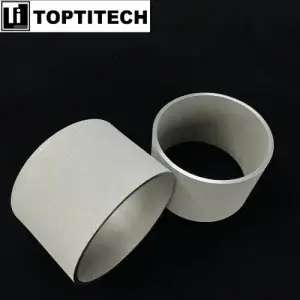
| Material | SS316L |
| Pore size | 1um |
| Diameter | 6mm |
| Length | 130mm |
| Technique | Sintering |
Overview of Sintered SS316L Powder Filter Technology
The sintered SS316L powder filter is a high-performance porous metal component engineered specifically for gas purification and getter applications in demanding industrial environments. Manufactured from premium-grade 316L stainless steel powder through advanced powder metallurgy techniques, this filter delivers exceptional filtration precision, mechanical durability, and chemical stability. Unlike conventional wire mesh or ceramic filters, the sintered SS316L powder filter features a three-dimensional interconnected pore network that traps particulate contaminants while permitting controlled gas flow. The resulting structure achieves filtration ratings from 0.5 to 100 microns, depending on customer specifications, with porosity levels typically ranging between 30% and 50%. This balance of permeability and retention efficiency makes the sintered SS316L powder filter an ideal choice for semiconductor fabrication, vacuum coating systems, analytical instrumentation, and reactive gas purification lines where material integrity and contamination control are non-negotiable.
Powder Metallurgy Manufacturing of Sintered SS316L Powder Filters
The production of each sintered SS316L powder filter begins with carefully classified 316L stainless steel powder, selected for particle size distribution, sphericity, and chemical composition conforming to ASTM A240 and ASTM F138 standards. The powder undergoes cold isostatic pressing (CIP) or uniaxial compaction within precision-engineered molds, forming a green compact that holds the desired near-net shape. Sintering follows in a controlled-atmosphere furnace at temperatures between 1100°C and 1350°C under vacuum or inert gas protection, where atomic diffusion bonds the particles at their contact points without fully melting the base material. This solid-state bonding mechanism preserves the low-carbon microstructure characteristic of the 316L grade while creating a mechanically robust, permeable body. Post-sintering operations such as machining, welding of end fittings, and surface finishing ensure dimensional accuracy within ±0.05 mm. The entire process yields a sintered SS316L powder filter with uniform pore distribution, eliminating the localized weakness and inconsistent flow paths common in competing filtration media.
Gas Purification Mechanism of Sintered SS316L Powder Filters
The sintered SS316L powder filter operates on three complementary purification principles. First, surface filtration captures particles larger than the rated pore size on the outer boundary of the filter element. Second, depth filtration entrains smaller particles within the tortuous internal pore channels, where inertial impaction and Brownian diffusion contribute to retention. Third, the extensive surface area of the porous metal matrix promotes adsorption of moisture and trace reactive species, particularly when the sintered SS316L powder filter is integrated with chemical getter materials. In gas getter systems, the filter functions as a protective barrier that prevents particulate shedding from getter pellets while allowing unimpeded reactive gas contact. The controlled pressure drop across the element — typically below 0.1 MPa at design flow rates — ensures that purification does not compromise system throughput, a critical consideration for high-vacuum and ultra-high-purity gas delivery circuits.
Industrial Applications of Sintered SS316L Powder Filters
Semiconductor manufacturing represents one of the primary deployment domains for the sintered SS316L powder filter. In wafer fabrication, these filters protect mass flow controllers, gas sticks, and process chambers from particulate contamination in argon, nitrogen, silane, and dopant gas streams. Their ability to withstand repeated thermal cycling without media migration makes them suitable for atomic layer deposition (ALD) and chemical vapor deposition (CVD) tooling. Vacuum systems benefit from the sintered SS316L powder filter as a foreline trap element, capturing pump oil backstreaming and process byproduct particulates before they reach high-vacuum gauges or analytical instruments. In getter purification assemblies, the filter serves as a retainer and flow distributor for zirconium-based or titanium-based getter materials, enabling efficient removal of oxygen, hydrogen, water vapor, and carbon monoxide from noble gas and nitrogen process streams. Additional applications span hydrogen fuel cell gas management, medical oxygen concentrators, and aerospace environmental control systems where long service life under vibrational load is essential.
Corrosion Resistance Advantages of SS316L in Sintered Powder Filters
The choice of 316L stainless steel for the sintered SS316L powder filter is driven by its superior resistance to intergranular corrosion, pitting, and crevice attack in chloride-containing environments. The low carbon content — limited to 0.03% maximum — prevents chromium carbide precipitation at grain boundaries during sintering and welding, preserving the passive chromium oxide layer responsible for corrosion protection. With 2–3% molybdenum content, the 316L alloy demonstrates markedly better performance than standard 304 stainless steel when exposed to halogenated process gases, acidic cleaning agents, and humidified gas streams. The sintered SS316L powder filter maintains this corrosion resistance throughout its porous structure, as the sintering process does not deplete alloying elements from particle surfaces. For end-users, this translates to reduced replacement frequency, elimination of rust particle contamination in process gases, and compatibility with aggressive chemical passivation and cleaning protocols commonly employed in pharmaceutical and semiconductor facilities.
Quality Control and Testing of Sintered SS316L Powder Filters
Every sintered SS316L powder filter undergoes a comprehensive quality assurance protocol before shipment. Bubble point testing per ISO 4003 determines the maximum pore size and confirms filtration rating integrity across the entire filter element. Permeability testing quantifies gas flow characteristics under standardized pressure differentials, ensuring batch-to-batch consistency. Helium leak detection at sensitivity levels down to 1×10⁻⁹ Pa·m³/s verifies structural soundness for vacuum and pressurized applications. Dimensional inspection using coordinate measuring machines (CMM) validates conformance to customer drawings, while scanning electron microscopy (SEM) provides visual confirmation of pore morphology and particle bonding quality. Chemical composition is verified via optical emission spectrometry, and mechanical properties including tensile strength and elongation are documented on material certification reports traceable to the originating mill heat number. This multi-layered quality framework ensures that each sintered SS316L powder filter meets the exacting standards demanded by B2B procurement professionals and engineering teams.
Customization Options for Sintered SS316L Powder Filters
TopTiTechs offers extensive customization of the sintered SS316L powder filter to match specific application requirements. Available geometries include discs, tubes, cups, cylinders, and custom profiles produced to customer-supplied drawings. Filtration grades span from submicron to coarse retention, with multi-layer gradient structures available for applications requiring both high dirt-holding capacity and fine filtration in a single element. End connections can be supplied as plain ends, threaded fittings in NPT or BSP standards, flanged terminations, or weld-ready preparations for orbital welding integration. Surface treatments such as electropolishing and passivation further enhance corrosion resistance and cleanroom compatibility. Engineering support is provided throughout the specification process, including computational fluid dynamics modeling of pressure drop characteristics and material selection guidance for unusual gas chemistries. Contact our technical sales team to discuss your sintered SS316L powder filter requirements and receive a tailored quotation within 48 hours.
Related products
 Metal Sintered Items
Sintered Titanium Powder Filter
- Metal Sintered Items
Titanium Filter Plate
- Metal Sintered Items
Porous Titanium Plate for PEM Electrolyzers
- Metal Sintered Items
2 mm SS316L Sintered Porous Filter Disc