
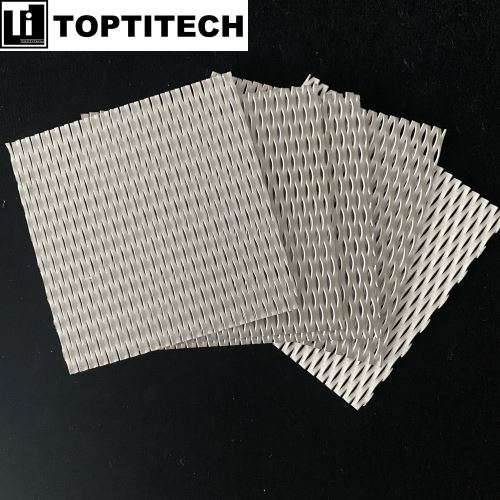
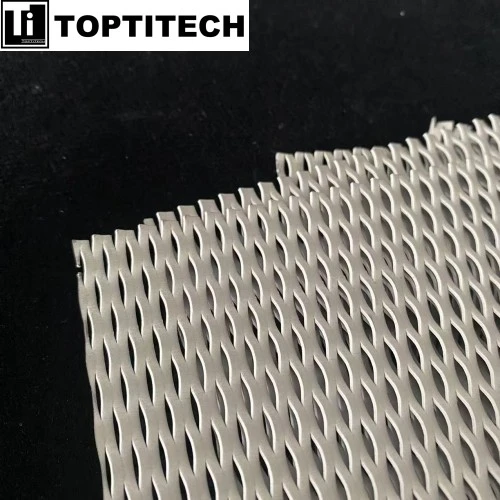
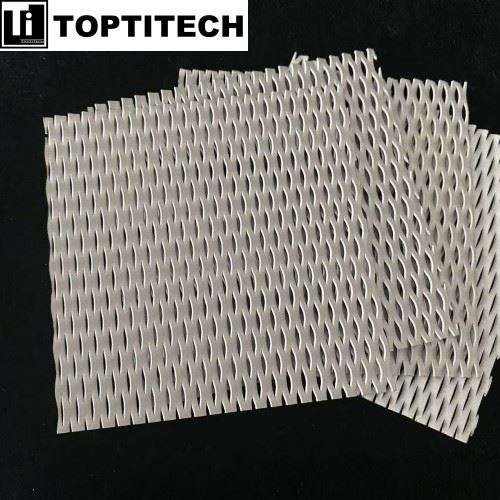
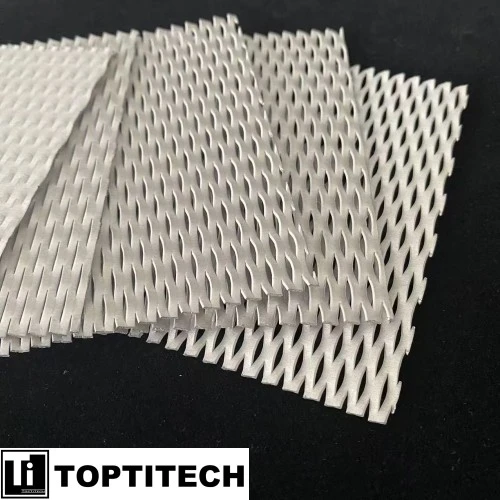
Titanium Expanded Mesh
Titanium expanded mesh for electrolyzer electrode substrates. 2.0 mm diamond opening, GR1/GR2, custom sheets.
Products Specifications
| Material | GR1 titanium | |||
| Mesh size | 3*6mm | |||
| Size | 100*100*2.0mm | |||
| Technique | Expanded | |||
Titanium Expanded Mesh: Multi-Functional Electrode for Industrial Electrolysis
Toptitech 2.0 mm titanium expanded mesh serves as a multi-functional component in industrial electrolysis systems — simultaneously acting as electrode substrate, current collector, and gas diffusion layer. Fabricated from GR1 titanium sheet through precision expansion and flattening, the mesh delivers a high open area with excellent in-plane electrical conductivity and through-plane gas permeability. The expanded metal structure offers several advantages over woven wire mesh or perforated plate alternatives: it is produced without material waste, maintains structural integrity at thin gauges, and provides a self-supporting three-dimensional profile that enhances active surface area and bubble release during electrolysis.
Precision Manufacturing of Titanium Expanded Mesh
Toptitech titanium expanded mesh begins with certified GR1 commercially pure titanium sheet, selected for its optimal combination of corrosion resistance, electrical conductivity, and mechanical workability. The manufacturing process employs a precision expansion technique in which the flat titanium sheet is simultaneously slit and stretched under controlled tension. Unlike perforation methods that punch out and discard material, expansion reconfigures the parent metal without generating scrap — every gram of titanium entering the process remains in the finished product. After the initial slitting-and-stretching stage, the expanded sheet passes through a flattening mill that cold-works the raised strands into a uniform planar profile. The flattening step determines the final thickness, strand width, and surface flatness of the titanium expanded mesh while also enhancing tensile strength through work hardening. Post-flattening, the mesh undergoes a multi-stage cleaning sequence — alkaline degreasing, pickling in a nitric-hydrofluoric acid bath to remove oxide scale, and a final deionized water rinse — to yield a metallurgically clean surface ready for coating or direct integration into electrolyzer stacks.
Structural Advantages of Titanium Expanded Mesh Over Woven and Perforated Alternatives
When evaluated against woven wire mesh and perforated plate, titanium expanded mesh offers a distinct set of structural and functional benefits that make it the preferred electrode substrate in modern electrolysis hardware. Woven mesh is assembled from individual wires that must be crimped and interlocked at every intersection; under the compressive load of a cell stack, these junctions can micro-fret, increasing contact resistance and creating localized hot spots. Titanium expanded mesh, by contrast, is a monolithic structure — each strand flows continuously from the parent sheet, eliminating junction resistance entirely and delivering superior in-plane electrical conductivity across the full electrode area. Perforated plate, while offering a monolithic alternative, suffers from a fundamental limitation in open area ratio. Punching circular holes through a solid sheet inevitably leaves a substantial fraction of the surface as blank metal, restricting through-plane gas transport. Titanium expanded mesh achieves open area ratios of 30 to 50 percent or more without sacrificing structural integrity, because the expansion process redistributes metal into load-bearing strands rather than removing it. The three-dimensional strand profile creates micro-channels that promote bubble detachment and prevent gas blanketing of the active electrode surface during high-current-density operation.
Industrial Applications of Titanium Expanded Mesh in Electrochemical Systems
Toptitech titanium expanded mesh has been qualified across a broad spectrum of industrial electrochemical processes. In alkaline water electrolysis, the mesh serves as the structural backbone for both anode and cathode electrodes, where its high open area facilitates efficient hydrogen and oxygen bubble evacuation while its GR1 titanium composition resists the hot concentrated potassium hydroxide electrolyte. PEM electrolyzer stacks benefit from titanium expanded mesh as a porous transport layer on the anode side, where the mesh must withstand the oxidative potential of oxygen evolution at the catalyst interface without passivating or corroding. Chlor-alkali membrane cells represent one of the most chemically aggressive environments in industrial electrochemistry, with anolyte chlorine gas and hot brine challenging even high-grade materials. Titanium expanded mesh coated with mixed metal oxide catalysts has become the industry-standard dimensionally stable anode in these cells. In seawater electrolysis for on-site sodium hypochlorite generation, the mesh’s resistance to chloride-induced pitting corrosion enables reliable operation in coastal and offshore installations. Electrochemical wastewater treatment systems increasingly adopt titanium expanded mesh for the anodic oxidation of recalcitrant organic pollutants. In each application, the titanium expanded mesh functions simultaneously as a structural support, current distributor, and gas management layer, reducing component count and simplifying cell assembly.
Catalytic Coating Options for Titanium Expanded Mesh Electrodes
The electrochemical performance of titanium expanded mesh electrodes depends critically on the catalytic coating applied to the substrate surface. Toptitech offers a range of platinum-group metal and mixed metal oxide coating services applied directly to the titanium expanded mesh, converting the bare substrate into a fully functional dimensionally stable electrode ready for installation. Platinum coatings, typically applied via thermal decomposition or electrodeposition, provide low overpotential for hydrogen evolution and are widely specified for cathode-side service in both alkaline and PEM water electrolyzers. Iridium-based coatings, including iridium dioxide and iridium-tantalum mixed oxide formulations, deliver exceptional stability under oxygen evolution conditions and are the coating of choice for anode applications in PEM electrolysis and chlor-alkali cells. The expanded mesh geometry enhances coating performance — strand edges and knuckle regions, which present higher local current density during operation, receive proportionally thicker deposition, improving electrode lifetime at the most demanding sites. Mixed metal oxide formulations such as IrO₂-Ta₂O₅ and RuO₂-IrO₂-TiO₂ can be tailored to specific operating conditions. All coated titanium expanded mesh electrodes undergo electrochemical characterization before shipment, including cyclic voltammetry and accelerated life testing, to verify coating loading, uniformity, and durability.
Quality Control Standards for Titanium Expanded Mesh
Toptitech applies a rigorous multi-stage quality assurance protocol to every batch of titanium expanded mesh produced. Incoming GR1 titanium sheet is verified against ASTM B265 chemical composition requirements and subjected to ultrasonic inspection to confirm freedom from lamination defects. During production, strand width, aperture dimensions, and overall thickness are monitored at defined intervals using laser micrometer and optical comparator systems, with statistical process control limits set tighter than the published dimensional tolerances. Finished sheets undergo comprehensive final inspection including visual examination under controlled lighting for surface defects, together with mechanical testing of tensile strength and elongation per lot. Electrical conductivity is verified using a four-point probe method across multiple sheet locations. For coated electrodes, additional QA steps include coating thickness measurement via X-ray fluorescence, adhesion testing, and electrochemical accelerated life testing on representative coupons. Full material certification is provided with every order, including mill test reports, dimensional conformance certificates, and coating characterization data where applicable.
Customization and Ordering of Titanium Expanded Mesh
Toptitech offers extensive customization of its titanium expanded mesh to match specific engineering requirements. Standard product configurations include sheets up to 1,200 mm in width and 2,400 mm in length, with the 2.0 mm thickness and 3 × 6 mm rhombic aperture serving as the baseline specification. Alternative aperture geometries — including 2 × 4 mm, 4 × 8 mm, and 5 × 10 mm patterns — can be produced to adjust the balance between open area and current-carrying cross-section. Thickness customization spans the range from 1.0 mm to 3.0 mm in GR1 titanium, with GR2 and GR7 grades available on request. Beyond dimensional customization, Toptitech can supply titanium expanded mesh in the as-expanded condition for applications benefitting from a pronounced three-dimensional profile, or with edge trimming, corner radius cutting, and current-collector tab welding performed in-house. For prototype and pilot-scale projects, small-quantity orders with expedited lead times are accommodated. Technical support — including material selection guidance, coating recommendation, and electrochemical performance modeling — is available throughout the evaluation and qualification process.
Related Products
Related products
 Metal Mesh
SS316L Five-Layer Sintered Wire Mesh Filter
- Metal Mesh
Titanium Woven Mesh (GR1/TA1)


