
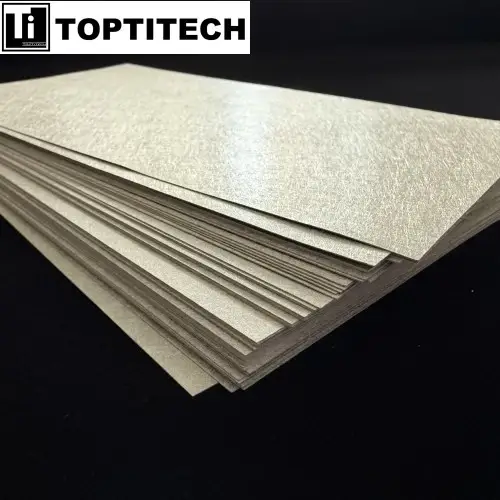
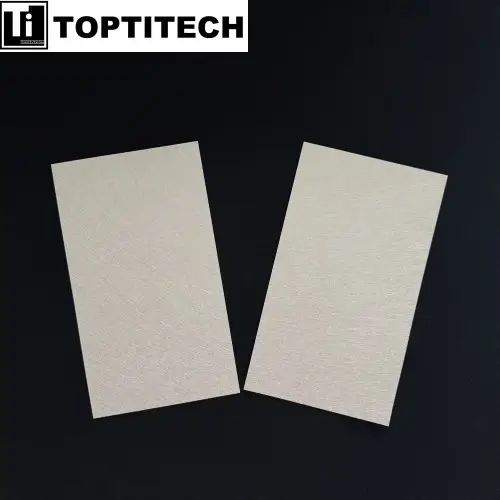
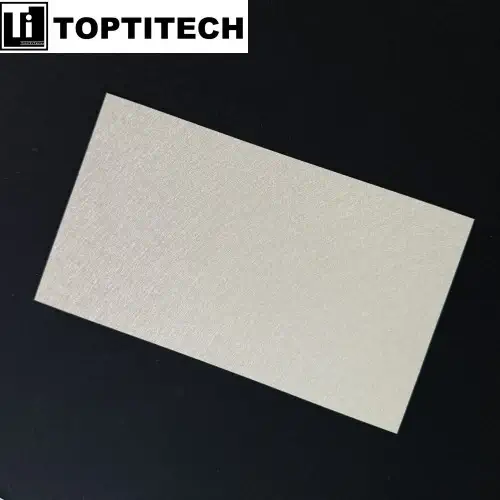

0.25 mm Stainless Steel Felt with 70% Porosity
0.25 mm stainless steel felt with 70% porosity for filtration and GDL. Uniform pore distribution, high permeability, custom sheet sizes.
Products Specifications
| Material | 316L | |||
| Filtration accuracy | 10um | |||
| Size | 208*120*0.25mm | |||
| Porosity | 70% | |||
| Technique | Sintering | |||
Overview of 0.25mm Stainless Steel Felt
This 0.25mm stainless steel felt with 70% porosity is an ultra-thin porous metal medium for precise fluid and gas control. Fine stainless steel fibers, randomly laid and sinter-bonded at every contact point, form an interconnected pore network with strong mechanical integrity. At 0.25mm it is among the thinnest sintered metal felt available, fitting compact filter stacks, fuel cell layers, and flow-distribution plates.
Unlike woven mesh, the nonwoven architecture creates tortuous flow that enhances particle capture and distributes flow evenly. The 70% porosity keeps pressure drop low while retaining structural rigidity. Standard 316L or 304 grades resist corrosion across oxidizing and mildly reducing environments. This stainless steel felt withstands temperatures near 600°C in non-oxidizing atmospheres and endures repeated thermal cycling without delamination or fiber shedding.
Manufacturing Process of Stainless Steel Felt
Production starts with drawing stainless steel wire into fibers 8 µm to 22 µm in diameter. The fibers are cut to length and formed into a randomized isotropic web through carding or air-lay. Web uniformity governs pore distribution in the finished stainless steel felt, making this the most critical step.
The web enters a continuous-belt vacuum sintering furnace at 1,050°C–1,350°C under a reducing or inert atmosphere. Solid-state diffusion bonds fibers at every intersection without organic binders, yielding a contaminant-free stainless steel felt. Post-sintering, precision calendering sets the 0.25mm thickness while preserving the 3D pore structure. Final inspection checks thickness, areal weight, and pore integrity before slitting to width.
Porosity and Permeability of Stainless Steel Felt
The 70% porosity balances flow capacity against mechanical robustness. Air permeability ranges from 1.0×10⁻¹² to 5.0×10⁻¹² m² depending on fiber diameter and sintering parameters. Tortuous pore channels force fluids through a three-dimensional path, promoting even velocity distribution across the filtration surface.
Bubble-point testing per ASTM E128 confirms mean pore sizes of approximately 15 µm to 40 µm, tunable through fiber grade and calendering pressure. The narrow pore distribution delivers sharp filtration cutoff for both clarification and absolute-rated service. The fiber network resists pore collapse under differential pressure, keeping permeability stable through the full service life—critical in cyclic processes with alternating forward-flow and backflush pulses.
Industrial Applications of Stainless Steel Felt
In polymer melt filtration, this stainless steel felt acts as a support and distribution layer inside screen changers, preventing dead zones that degrade polymer quality during extrusion above 300°C. For fuel cells and electrolyzers, it serves as a gas diffusion layer and current collector, combining conductivity with controlled porosity for efficient reactant distribution and water removal.
Pharmaceutical and food processing uses this stainless steel felt as a sterile barrier and fluidizing element. Its smooth surface resists bacterial colonization and withstands repeated steam sterilization at 121°C–135°C. Other uses include acoustic attenuation in high-temperature exhaust, flame arresting, and aeration spargers for bioreactors and wastewater treatment.
Stainless Steel Felt vs. Titanium Felt: A Technical Comparison
Both belong to the sintered metal fiber family but serve distinct windows. Stainless steel felt, made from 316L or 304 fibers, offers strong cost-to-performance below 600°C in oxidizing atmospheres and neutral-to-alkaline fluids. Titanium felt costs more but resists chloride-induced pitting, making it essential for seawater, brine, and hot halide acids.
Stainless steel felt provides higher tensile strength and stiffness, simplifying automated handling. Titanium felt is roughly 40% lighter, suiting weight-sensitive designs. Both use the same sintering method, but stainless steel felt offers a wider fiber diameter range for finer pore control. For most filtration outside aggressive halide environments, stainless steel felt delivers the best balance of performance, longevity, and cost.
Quality Control for Stainless Steel Felt
TOPTITECHS applies a multi-stage quality protocol to every batch. Incoming fiber undergoes spectroscopy for chemistry verification and laser diffraction for diameter distribution. During production, continuous furnace monitoring of temperature, belt speed, and dew point ensures uniform treatment across every meter.
Finished-product inspection includes multi-point thickness measurement with 1 µm resolution, air permeability per ISO 4022, and bubble-point testing per ASTM E128. Visual checks identify surface defects, clumps, and edge flaws; tensile testing per ASTM E8 is run on each lot. Any stainless steel felt exceeding ±0.02 mm tolerance or missing the permeability threshold is rejected, ensuring consistent quality for OEM and regulated-industry customers.
Customization Options for Stainless Steel Felt
TOPTITECHS tailors stainless steel felt to specific needs. Thickness ranges from 0.15mm to 2.0mm by adjusting web weight and calendering pressure. Porosity spans 50% to 85% through fiber diameter, web density, and sintering parameters.
The felt is supplied in rolls, slit coils, or die-cut shapes—discs, rectangles, and complex profiles via laser or waterjet. Surface treatments including passivation, electropolishing, and PTFE coating enhance corrosion resistance or add hydrophobic and oleophobic properties. For greater rigidity, it can be laminated to woven wire mesh. Custom alloys such as 310S, 904L, or Hastelloy are offered where 316L falls short. Every custom order includes application engineering consultation to validate material selection before production.
Related Products
Related products
 Metal Sintered Items
Coated Titanium PTL
- Metal Sintered Items
Porous Nickel Plate (Sintered Nickel Powder, GDL)
- Metal Sintered Items
Sintered Nickel Fiber Felt for GDL & PTL (PEM/AEM Electrolyzers)
- Metal Sintered Items
0.2 mm Sintered SS316L Fiber Felt for AEM Electrolyzer


