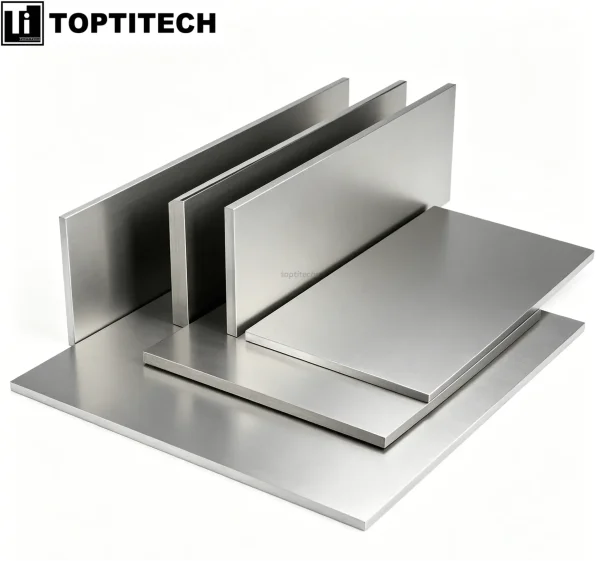
2 mm Titanium Sheet (Grade 1)
2 mm titanium sheet, Grade 1 (TA1), ASTM B265. Uniform thickness pure titanium plate for tanks, ducts and structural fabrication.
Products Specifications
2.0mm Grade1/TA1 Pure Titanium Sheet
Overview
The 2.0mm Grade1/TA1 pure titanium sheet is a versatile cold-rolled titanium sheet compliant with ASTM B265 specifications and is among the most widely specified gauges across chemical anti-corrosion engineering, environmental protection equipment, and electrolytic apparatus construction. Manufactured from commercially pure Grade 1 titanium (TA1 per GB/T 3620.1, ASTM Grade 1 / UNS R50250) with titanium content exceeding 99.5%, the 2.0mm sheet delivers the optimal combination of non-magnetic behaviour, cold processability, and chemical inertness for applications demanding both fabricability and long-term service reliability.
Standard supply form is 2.0 mm × 1000 mm × 2000 mm in the annealed M condition with a smooth bright surface. Cut-to-size and custom dimensions are readily available.
Material Specification and Chemical Composition
| Element | Ti (base) | Fe | O | C | N | H | Other (total) |
|---|---|---|---|---|---|---|---|
| Requirement | ≥99.5% | ≤0.20% | ≤0.18% | ≤0.08% | ≤0.03% | ≤0.015% | ≤0.40% |
Compliance standards: GB/T 3621-2007 and ASTM B265. Delivery condition: M (fully annealed), equiaxed alpha phase microstructure with no precipitation-hardening phases.
Physical and Mechanical Properties
| Property | Value |
|---|---|
| Density | 4.51 g/cm³ (approximately 57% of SS304) |
| Melting point | 1668 °C |
| Thermal conductivity | 17 W/(m·K) |
| Coefficient of thermal expansion | 8.6 × 10⁻⁶ /°C |
| Magnetic behaviour | Fully non-magnetic |
| Hardness | HV 120–150 / HB 60–70 |
| Tensile strength (Rm) | 240–340 MPa (min. 240 MPa) |
| 0.2% proof stress (Rp0.2) | ≥170 MPa |
| Elongation at fracture (δ₅) | ≥30% |
| Reduction of area | ≥35% |
| Impact toughness | 150–200 J/cm² (no embrittlement to −196 °C) |
| Fatigue limit (10⁷ cycles) | ~140 MPa |
Plate Specification Categories
| Category | Thickness Range | Surface Condition | Typical Uses |
|---|---|---|---|
| Cold-rolled sheet | 0.3–6.0 mm | Bright, high-precision | Sheet metal, stamping, decorative components |
| Medium plate | 6–25 mm | Bright or pickled | General structural parts, corrosion-resistant equipment shells |
| Hot-rolled heavy plate | 25–60 mm | Mill scale (requires pickling / machining) | Thick-wall structural fabrications |
Standard delivery condition: M (annealed). Hard (Y) and hot-rolled (R) conditions available on request.
Corrosion Resistance
Excellent resistance: seawater and chloride-containing solutions, nitric acid, acetic acid, citric acid, food-grade organic acids, dilute alkali at ambient temperature, hydrogen peroxide, hypochlorite, pharmaceutical and food-contact streams. Seawater corrosion rate <0.001 mm/year; no pitting or crevice corrosion.
Incompatible media: hydrofluoric acid (HF), hot concentrated hydrochloric acid, dilute sulfuric and phosphoric acids, anhydrous dry chlorine gas, hot fuming nitric acid, molten strong alkalis.
Applications of 2.0mm TA1 Titanium Sheet
At 2.0 mm, the sheet provides a step up in bending stiffness and surface hardness compared with thinner gauges while fully retaining cold-forming capability. Key applications include:
- Chemical anti-corrosion equipment — reaction vessel liners, manifold blanks, flange faces, and inner wall sheets for chemical reactors handling nitric acid, organic acids, and halide streams where stainless steel suffers chloride-induced pitting.
- Environmental protection plant — flue-gas desulfurisation scrubber liners, electrochemical wastewater treatment cell plates, and wet-electrostatic-precipitator corrosion-resistant structural panels.
- Cold-forming sheet metal assemblies — brackets, formed housings, access covers, and enclosures for process plant requiring lightweight non-magnetic construction; supports various cold processing operations including roll-forming, press-braking, and hydroforming.
- Electrolytic cell components — anode plates, current distributor sheets, and separator blanks in water electrolysis, electroplating, and anodising lines.
- Marine and offshore facings — hull splash-zone corrosion cladding, pipe penetration cover plates, and structural corrosion-protection facings in coastal and offshore installations.
Fabrication Guidelines
Cold forming: Excellent — 90° bending, roll forming, deep drawing, and hydroforming without pre-heating. Single-pass cold deformation ≥40%. Intermediate anneal at 670–720 °C required only after severe cold work accumulation.
Welding: GTAW (TIG) preferred; GMAW applicable for heavier cross-sections. Use ER Ti-1 filler wire; full argon shielding of weld pool, back face, and heat-affected zone is mandatory throughout the weld and cooling cycle.
Machining: Use titanium-grade carbide or ceramic tooling, low cutting speed (30–60 m/min), high feed, and continuous coolant flood to prevent built-up edge.
Hot working: Processing temperature 800–900 °C under vacuum or argon atmosphere; mandatory inert gas protection to prevent high-temperature oxygen absorption and hydrogen embrittlement.
Annealing: 670–720 °C, 30–120 min, air cool, vacuum or inert gas atmosphere. No quench-hardening effect exists for commercially pure titanium.
Galvanic compatibility: Where 2.0mm TA1 titanium sheet contacts carbon steel structural members, install insulating gaskets or isolation tape to prevent galvanic corrosion of the steel.
Grade Selection: TA1 vs TA2
| Parameter | TA1 (Grade 1) — this product | TA2 (Grade 2) |
|---|---|---|
| Purity / impurity level | Higher purity, lower impurities | Slightly higher impurities |
| Tensile strength (Rm) | 240–340 MPa | 345–450 MPa |
| Elongation (δ₅) | ≥30% — best cold formability | ≥20% |
| Cold forming | Optimal — deep drawing, complex sheet metal, tight bends | Good — standard forming, moderate radii |
| Primary applications | Thin-plate deep drawing, medical implants, thin-walled desalination parts, precision non-magnetic components | General chemical equipment, load-bearing thick-plate structures, conventional corrosion-resistant shells |
| Cost | Slightly higher | More cost-effective |
Key Usage Precautions
- Fluorine-containing media: Prohibit prolonged contact with HF or any fluoride-bearing liquid; oxide film failure leads to rapid through-wall corrosion.
- High-temperature processing and welding: Must be performed under inert gas (argon) protection throughout; atmospheric oxygen or hydrogen causes embrittlement of the heat-affected zone.
- Large-deformation cold working: Intermediate annealing is required after heavy cold work to restore ductility and prevent workpiece cracking.
- Medical-grade hydrogen control: Hydrogen content must be strictly controlled to meet implant standards (ISO 5832-2 or equivalent); specify low-H lots when ordering for implant applications.
- Galvanic isolation: When assembling titanium sheet with carbon steel structural members, insulating gaskets or isolation tape must be fitted at all contact points to prevent galvanic corrosion of the steel.
Quality, Certification, and Customization
Every 2.0mm TA1 titanium sheet is delivered with mill test reports covering chemical composition, tensile and elongation results, and full dimensional records, traceable to the heat number. TOPTITECHS ISO 9001 certification covers the full manufacturing and inspection chain. Custom options include non-standard dimensions, cut-to-size blanks, slit coil widths, alternative surface finishes (electropolished, mechanically polished, acid-pickled matte), and tighter-tolerance lots for precision fabrication. Browse the complete titanium sheets & plates range to find the right thickness and grade for your application.
Related Products
Related products
 Titanium Sheets & Plates
Titanium Foil (Grade 1, 0.05-0.3 mm)
- Titanium Sheets & Plates
5 mm Titanium Plate (Grade 1)
- Titanium Sheets & Plates
4 mm Titanium Plate (Grade 1)
- Titanium Sheets & Plates
2.5 mm Titanium Sheet (Grade 1)