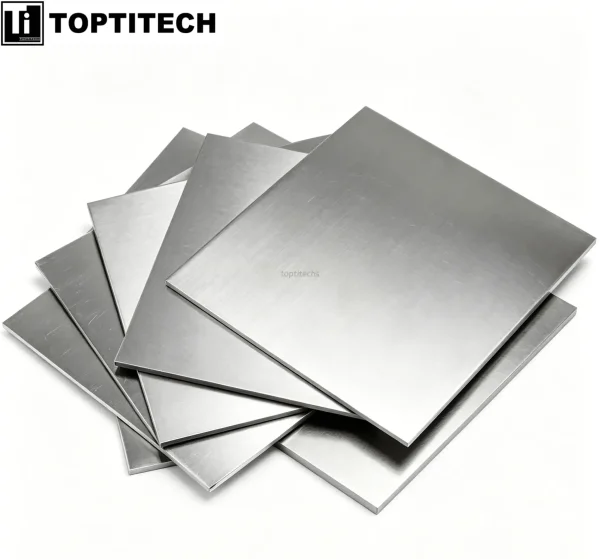
5 mm Titanium Plate (Grade 1)
5 mm titanium plate, Grade 1 (TA1), ASTM B265. Industrial pure titanium plate with certified composition, custom cutting and supply.
Products Specifications
5.0mm Grade1/TA1 Pure Titanium Sheet
Overview
The 5.0mm Grade1/TA1 pure titanium sheet is a heavy-spec industrial titanium plate conforming to ASTM B265 global standards, representing the upper boundary of the cold-rolled TA1 sheet product range. At 5.0 mm, the plate provides substantial section modulus, pressure-bearing capability, and dimensional rigidity while retaining the exceptional corrosion resistance, non-magnetism, and low-temperature toughness inherent to Grade 1 commercially pure titanium (TA1 per GB/T 3620.1; ASTM Grade 1 / UNS R50250).
This gauge is widely specified for thick-wall anti-corrosion components, marine engineering structures, and heavy industrial equipment manufacturing where both structural performance and long-term immunity to aggressive chemical or marine environments are mandatory. Standard supply form is 5.0 mm × 1000 mm × 2000 mm in the annealed M condition with a smooth bright surface. Cut-to-size and custom configurations are available.
Material Specification and Chemical Composition
| Element | Ti (base) | Fe | O | C | N | H | Other (total) |
|---|---|---|---|---|---|---|---|
| Requirement | ≥99.5% | ≤0.20% | ≤0.18% | ≤0.08% | ≤0.03% | ≤0.015% | ≤0.40% |
Standards: GB/T 3620.1-2007 (grade TA1), GB/T 3621-2007 (sheet and plate product), ASTM B265. Delivery condition: M (fully annealed), equiaxed alpha-phase microstructure.
Physical and Mechanical Properties
| Property | Value |
|---|---|
| Density | 4.51 g/cm³ (≈57% of SS304 — significant weight advantage in structural applications) |
| Melting point | 1668 °C |
| Thermal conductivity | 17 W/(m·K) |
| Coefficient of thermal expansion | 8.6 × 10⁻⁶ /°C |
| Magnetic behaviour | Fully non-magnetic |
| Hardness | HV 120–150 / HB 60–70 |
| Tensile strength (Rm) | 240–340 MPa (min. 240 MPa) |
| 0.2% proof stress (Rp0.2) | ≥170 MPa |
| Elongation at fracture (δ₅) | ≥30% |
| Reduction of area | ≥35% |
| Impact toughness | 150–200 J/cm² (no embrittlement to −196 °C) |
| Fatigue limit (10⁷ cycles) | ~140 MPa |
At 5.0 mm, the titanium plate offers a specific stiffness (stiffness per unit weight) comparable to structural steel at roughly 43% of steel’s weight, creating significant engineering advantages in aerospace-adjacent and weight-sensitive marine structures.
Plate Specification Categories
| Category | Thickness Range | Surface Condition | Typical Uses |
|---|---|---|---|
| Cold-rolled sheet | 0.3–6.0 mm | Bright, high-precision | Sheet metal, stamping, decorative components |
| Medium plate | 6–25 mm | Bright or pickled | General structural parts, corrosion-resistant equipment shells |
| Hot-rolled heavy plate | 25–60 mm | Mill scale (requires pickling / machining) | Thick-wall structural fabrications |
Standard delivery condition: M (annealed). Hard (Y) and hot-rolled (R) conditions available on request.
Corrosion Resistance
Excellent resistance: seawater and ocean environments (corrosion rate <0.001 mm/year, no pitting or crevice attack), salt spray, chloride-bearing process streams, nitric acid, acetic acid, citric acid and food-grade organic acids, dilute alkali at ambient temperature, hydrogen peroxide, hypochlorite solutions, food and pharmaceutical contact media.
Incompatible media: hydrofluoric acid (HF), hot concentrated hydrochloric acid, dilute sulfuric and phosphoric acids, anhydrous dry chlorine, hot fuming nitric acid, molten caustic alkalis.
Applications of 5.0mm TA1 Titanium Sheet
The 5.0mm gauge addresses the heaviest-duty end of the TA1 cold-rolled product range:
- Thick-wall anti-corrosion fabrications — weld-fabricated titanium vessels, tank walls, reactor bodies, and pipe-spool liner plates for chlor-alkali, nitric acid, fine-chemical, and pharmaceutical plant where plate thickness is driven by pressure rating or mechanical loading rather than corrosion allowance.
- Marine engineering structures — hull plating inserts for ice-class vessels and offshore supply ships, stem and propeller shaft brackets, sea-chest fronts, and below-waterline structural plates demanding continuous seawater immersion service over 20–30 year vessel lifetimes without any corrosion allowance.
- Industrial equipment manufacturing — corrosion-resistant pump and valve body blanks, filter housing shells, agitator baffles, centrifuge basket plates, and structural machine frames for chemical and pharmaceutical production equipment requiring a combination of dimensional rigidity and chemical inertness.
- Desalination and energy conversion structures — evaporator shell plates, flash chamber liners, brine heater end walls, and MSF/MED distillation unit structural panels in large-scale seawater desalination plants.
- Electrochemical and electrolytic reactor structures — heavy-gauge cell body walls, electrode support frames, bus-bar contact plates, and structural flanges in industrial electrochemical water treatment, electrolytic metal production, and large-format electrolysis systems.
TA1 vs TA2 — Selection Guidance for 5.0mm Plate
| Parameter | TA1 / Grade 1 (this product) | TA2 / Grade 2 |
|---|---|---|
| Tensile strength (Rm) | 240–340 MPa | 345–450 MPa |
| Elongation (δ₅) | ≥30% (superior) | ≥20% |
| Cold forming | Better — tolerable for press-braking within spring-back limits | Good for standard press-brake and roll forming |
| Primary value at 5mm | Maximum corrosion resistance + non-magnetic + biocompatibility | Higher strength + better cost-efficiency for structural duty |
| Typical applications at 5mm | Marine pressure hulls, medical non-magnetic structures, corrosion-critical reactors | General chemical equipment bodies, pressure vessel shells |
Fabrication Guidelines
Cold forming: Feasible for press-brake bending and roll forming with appropriate springback compensation; multi-step deep drawing requires intermediate annealing at 670–720 °C between passes. The 5.0mm TA1 sheet is more amenable to warm forming (400–600 °C, inert atmosphere) for tight geometries.
Welding: GTAW (TIG) with multi-pass technique using ER Ti-1 filler is standard for 5.0mm. Complete argon shielding of weld pool, back face, and heat-affected zone throughout the weld cycle and cool-down to below 400 °C is essential. Plasma arc welding (PAW) and electron beam welding (EBW) are applicable for production environments requiring higher throughput. All titanium welding procedures must be qualified per ASME IX or AWS D1.9, as applicable.
Machining: Carbide tooling, 30–60 m/min surface speed, high feed rate, and continuous flood coolant. At 5.0mm, shearing can produce work-hardened edges; surface grinding or milling to final edge dimensions is recommended for structural weld preparations.
Hot working: Processing temperature 800–900 °C under vacuum or argon atmosphere; mandatory inert gas protection to prevent high-temperature oxygen absorption and hydrogen embrittlement.
Thermal treatment: Anneal at 670–720 °C, 60–120 min, air cool, in vacuum or inert gas atmosphere. No quench-hardening response exists for commercially pure titanium. Hydrogen content should be monitored for high-cycle fatigue applications.
Key Usage Precautions
- Fluorine-containing media: Prohibit prolonged contact with HF or any fluoride-bearing liquid; oxide film failure leads to rapid through-wall corrosion.
- High-temperature processing and welding: Must be performed under inert gas (argon) protection throughout; atmospheric oxygen or hydrogen causes embrittlement of the heat-affected zone.
- Large-deformation cold working: Intermediate annealing is required after heavy cold work to restore ductility and prevent workpiece cracking.
- Medical-grade hydrogen control: Hydrogen content must be strictly controlled to meet implant standards (ISO 5832-2 or equivalent); specify low-H lots when ordering for implant applications.
- Galvanic isolation: When assembling titanium sheet with carbon steel structural members, insulating gaskets or isolation tape must be fitted at all contact points to prevent galvanic corrosion of the steel.
Quality, Certification, and Customization
Every 5.0mm TA1 pure titanium sheet is supplied with full mill test reports covering chemical composition (by spectrometric analysis), tensile strength, elongation, and dimensional inspection, with traceability to the originating melting heat. TOPTITECHS ISO 9001 quality management supports demanding material qualification requirements including marine class society approval (DNV GL, ABS, Lloyd’s Register, BV), ASME material certification, and pharmaceutical GMP documentation.
Available customisation includes cut-to-size and profiled blanks, slit coil stock, surface finishes (bright-annealed, electropolished, mechanically polished, acid-pickled), tight thickness and flatness tolerances, third-party inspection at source, and special documentary packages (RoHS, REACH, conflict minerals declarations). Browse the complete titanium sheets & plates range for the full selection of TA1 and TA2 thicknesses, and contact TOPTITECHS engineering for application-specific grade and thickness selection guidance.
Related Products
Related products
 Titanium Sheets & Plates
Titanium Strip & Coil (Grade 1/2)
- Titanium Sheets & Plates
4 mm Titanium Plate (Grade 1)
- Titanium Sheets & Plates
2 mm Titanium Sheet (Grade 1)
- Titanium Sheets & Plates
0.5 mm Titanium Sheet (Grade 1)