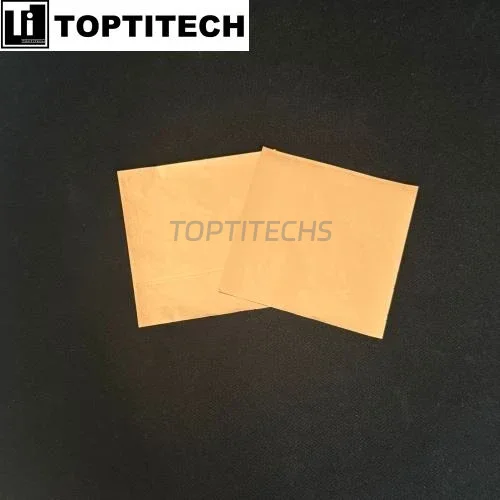
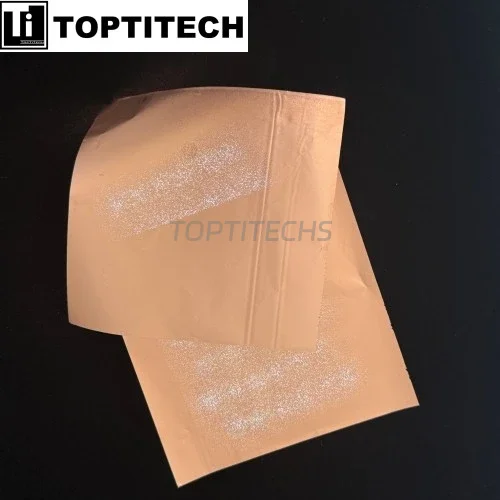
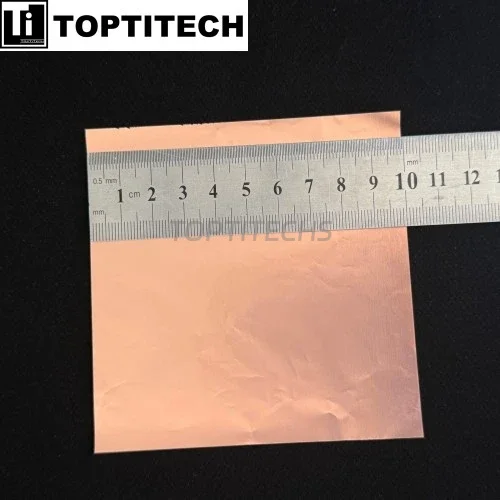
A laser-perforated copper foil starts as a 12 µm (0.012 mm) high-purity electrodeposited copper foil (≥99.8% Cu) and is machined on a femtosecond/picosecond laser micro-drilling system into a uniform field of 6–8 µm through-holes. The cold-ablation process leaves burr-free hole edges and an almost zero heat-affected zone, so the foil keeps its tensile strength, conductivity and surface finish while gaining a precisely controlled open area.
1Key Specifications
Because the perforations act as electrolyte transport channels and stress-relief paths, the foil works where solid collectors struggle: fast-charge cells, silicon/silicon-carbon composite anodes that swell during lithiation, and high-power cylindrical, prismatic or pouch designs.
| Parameter | Value |
|---|---|
| Base material | High-purity electrodeposited copper foil, ≥99.8% Cu |
| Foil thickness | 12 µm (0.012 mm); other gauges on request |
| Sheet size | 100 × 100 mm standard; custom sizes available |
| Hole diameter | 6–8 µm through-holes (uniform) |
| Hole arrangement | Square lattice standard; hexagonal lattice and custom pitch available |
| Diameter tolerance | ±1 µm |
| Positional accuracy | ±2 µm |
| Process | Femtosecond/picosecond laser micro-drilling |
The ultrashort-pulse laser removes material by cold ablation rather than melting, which is the difference that makes 12 µm and thinner foils processable at all. Hole-to-hole diameter variation is held within ±1 µm and positional accuracy within ±2 µm, reproduced sheet to sheet — the dimensional consistency large-format electrode manufacturing depends on.
2Key Features
Through-hole diameter held within ±1 µm and positional accuracy within ±2 µm, reproduced sheet to sheet by program-controlled laser drilling.
The micro-pores shorten electrolyte diffusion paths, reducing concentration polarization at 4C–6C charge/discharge rates.
The open structure absorbs the volume change of high-capacity silicon anodes, limiting delamination and slowing capacity fade over cycling.
Removing non-active copper cuts current-collector weight versus solid foil of equal thickness — a direct gain in gravimetric energy density.
The pores give the active layer a mechanical interlock, lowering interfacial resistance between coating and collector.
Perforated foil conforms better during winding and stacking in cylindrical, prismatic and pouch formats.
Laser drilling — not mechanical punching or etching — keeps dimensional consistency critical for large-format electrode manufacturing.
3Applications
- Anode current collector for fast-charging lithium-ion cells (4C–6C).
- Current collector for silicon / silicon-carbon composite anodes in high-energy-density EV batteries.
- High-power industrial energy-storage cells and cylindrical 4680-type formats.
- Research and pilot-line evaluation of micro-perforated and 3D current collectors.
For semi-solid and solid-state electrode stacks, the perforated architecture is also used where wetting and interfacial contact need to be engineered at the collector level.
4FAQ
Does perforating the foil weaken it mechanically?
With ultrashort-pulse laser drilling the heat-affected zone stays minimal, so the remaining ligament structure keeps most of the base foil’s strength. Mechanical punching or chemical etching is far more damaging to thin foils; that is why laser micro-drilling is specified for 12 µm and thinner material.
What hole patterns can you make?
Square and hexagonal lattices are standard. Hole pitch, density and pattern are set by your electrode design and target open-area ratio; we adjust the drilling program and verify hole size with optical inspection before shipping.
Can you supply foil thinner than 12 µm?
Yes. 8–10 µm base foils can be processed with the same laser system, although handling and hole-tolerance requirements are tighter. Tell us the gauge, hole size and open-area target for a quote.
Is this foil suitable for solid-state battery research?
The perforated architecture is also used in semi-solid and solid-state electrode stacks where wetting and interfacial contact need to be engineered at the collector level. Contact us with your cell format for a recommendation.
Do you offer sample sheets for evaluation?
Yes. Small-batch evaluation sheets are available so your cell team can validate wetting, cycling and adhesion before committing to production quantities.
Request a quote for laser-perforated copper foil. TOPTITECHS supplies 12 µm (and 8–10 µm) laser-perforated copper foil with custom hole patterns, verified by optical inspection, from Baoji, China. Contact us with your gauge, hole size and open-area target for pricing and evaluation samples.
Related products
 Other metal material products
Pure Zinc Plate (Battery Anode Substrate)
- Other metal material products
75 PPI Nickel Foam for Battery Electrodes
- Other metal material products
Pure Zinc Plate for Battery Anodes
- Other metal material products
Nickel Foam Sheet for Battery Electrodes