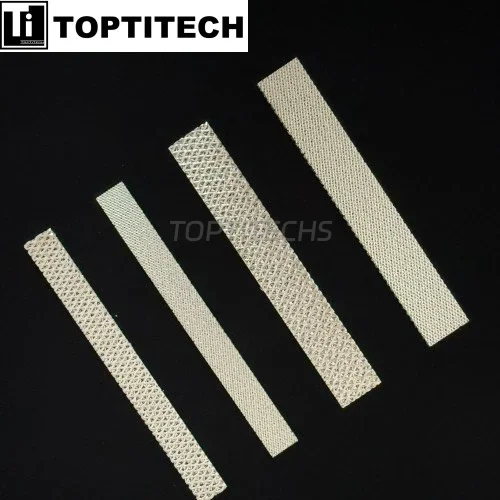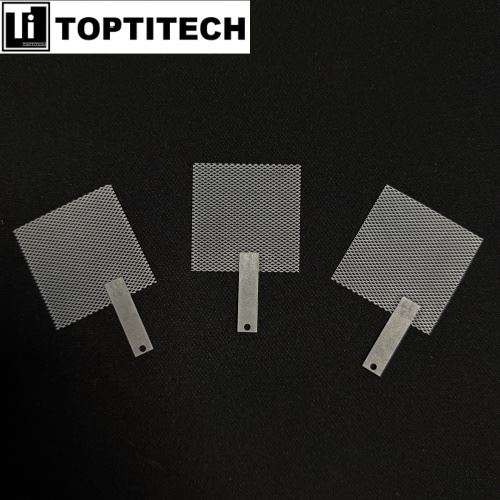
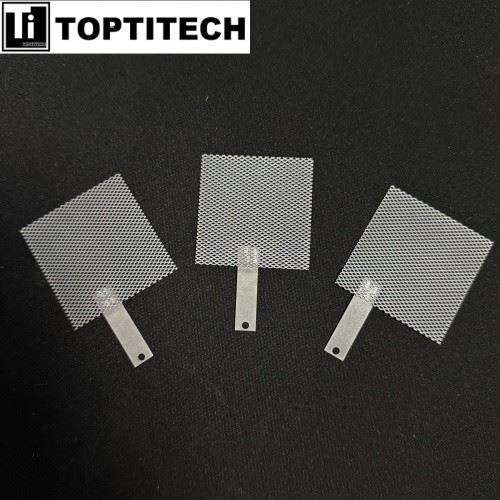
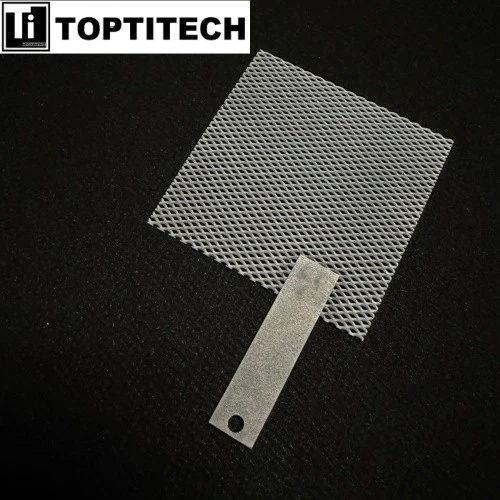
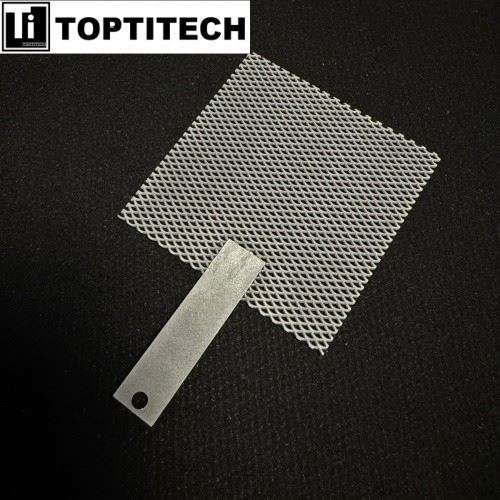
Titanium Expanded Mesh with Ir-Ta Coating (Semiconductor Plating)
Titanium expanded mesh with Ir-Ta coating for semiconductor plating anodes. 2×3 mm diamond hole, corrosion resistant, high current capacity.
Products Specifications
| Material | GR1 titanium | |||
| Pore size | 2*3mm | |||
| Thickness | 0.5mm | |||
| Coating | 8-12um Ir-Ta coating | |||
| Size | 55*55mm(Customized according to the drawing) | |||
Titanium Expanded Mesh with Ir-Ta Coating for Semiconductor Plating Anodes — 2*3mm Diamond Aperture, 0.5mm Strand
Overview of the Titanium Expanded Mesh Ir-Ta Coating Anode
The titanium expanded mesh Ir-Ta coating anode is an insoluble dimensionally stable electrode purpose-built for advanced semiconductor electroplating. Constructed from ASTM B265 Grade 1 titanium expanded mesh with a 2×3mm diamond aperture and 0.5mm strand thickness, the substrate is coated with an iridium-tantalum mixed metal oxide layer deposited at 8–12μm thickness. This titanium expanded mesh Ir-Ta coating combination delivers electrochemical stability in aggressive acidic copper sulfate and methanesulfonic acid electrolytes at operating current densities of 2–15 A/dm², with a Tafel slope 40–60 mV per decade lower than uncoated titanium. Unlike soluble copper anodes that generate sludge and dimensional drift, the titanium expanded mesh Ir-Ta coating anode eliminates particle contamination that would otherwise cause wafer-level defects at sub-100nm technology nodes.
Semiconductor fabs choose the titanium expanded mesh Ir-Ta coating anode over bare titanium or platinized alternatives because the Ir-Ta mixed oxide resists dissolution in acidic copper, tin, and nickel plating electrolytes while maintaining stable oxygen evolution over thousands of operating hours. The tantalum oxide component forms a chemically inert matrix that passivates micro-cracks, preventing electrolyte penetration to the titanium substrate. The expanded mesh geometry provides an open area exceeding 60%, facilitating unimpeded electrolyte flow, uniform current distribution, and effective bubble disengagement — all critical for uniform plating thickness across 300mm wafer formats. Wear rates remain below 0.5 mg iridium per ampere-year in field-deployed systems.
The titanium expanded mesh Ir-Ta coating anode serves as a critical component in copper damascene electroplating, tin-silver and nickel-palladium bump plating for advanced packaging, through-silicon via metallization for 3D integration, and fan-out wafer-level packaging. The standard configuration measures 55×55mm with mesh strand width of 1.0–2.5mm and diamond aperture ranging from 2×3mm, though custom sheet dimensions up to 1,500mm are produced to customer drawings. The burr-free edges and thickness tolerance of ±0.03mm ensure seamless integration into plating tool anode chambers without electrical discontinuity or flow disruption.
Manufacturing Process
Fabrication of the titanium expanded mesh Ir-Ta coating anode begins with precision expansion of ASTM B265 Grade 1 titanium sheet into the specified 2×3mm diamond aperture pattern using CNC-controlled expansion tooling that maintains strand width tolerance within ±0.05mm. The expanded mesh then undergoes alkaline degreasing to remove forming lubricants, followed by oxalic acid etching at controlled concentration and temperature to strip the native titanium dioxide passive layer and create a micro-roughened surface profile essential for mechanical interlock of the catalytic coating. Surface roughness after etching is verified by profilometry before coating application.
The Ir-Ta precursor solution — formulated with optimized iridium-to-tantalum ratio for acidic sulfate and methanesulfonic acid electrolyte service — is applied via precision brush or dip coating in a cleanroom environment. Each coating layer is thermally decomposed in a controlled-atmosphere furnace ramped to 450–520°C, where the metal chlorides oxidize and bond to the titanium substrate. Multiple coating-thermal cycles are repeated until X-ray fluorescence measurement confirms the target iridium loading between 8 and 25 g/m². Post-coating quality verification includes adhesion testing per ASTM B571 thermal shock method, potentiostatic polarization scans for oxygen evolution stability, and optionally SEM/EDS elemental mapping. The process produces a dense, crack-free oxide film with predictable electrochemical behavior and consistent coating distribution across the entire active anode surface.
Depth Filtration Characteristics
While the titanium expanded mesh Ir-Ta coating anode is an electrode rather than a traditional filter, its expanded mesh architecture functions as a flow distribution and gas evolution medium that directly impacts plating uniformity. The 2×3mm diamond apertures create tortuous flow paths that break up laminar electrolyte streams, promoting micro-turbulence at the anode-cathode gap and reducing mass transport boundary layer thickness. This enhanced convection accelerates copper ion delivery to the wafer surface, enabling uniform plating at current densities exceeding 10 A/dm² without the edge-beading defects common to solid plate anodes.
The open-cell mesh structure of the titanium expanded mesh Ir-Ta coating anode also serves as an effective gas disengagement surface. Oxygen bubbles evolved at the anode surface during electroplating readily detach from the expanded mesh and rise through the apertures rather than accumulating and blocking active sites — a phenomenon known as gas blinding that causes localized current hot-spots on solid anodes. The three-dimensional mesh geometry provides over 60% open area, ensuring that gas evolution at one location does not impede electrolyte access to adjacent regions. This uniform gas release characteristic is particularly valuable in high-current-density processes where bubble accumulation would otherwise introduce non-uniformity into the deposited metal film thickness and grain structure.
Industrial Applications
In copper damascene CMP integration, the titanium expanded mesh Ir-Ta coating anode replaces soluble copper anodes in the electroplating cell, eliminating the formation of anode sludge that generates killer particles. The 2×3mm apertures permit unimpeded flow of the acid copper plating solution containing proprietary organic additives (suppressor, accelerator, leveler), which remain chemically stable in contact with the Ir-Ta oxide surface — unlike platinum anodes that degrade certain organic brightener chemistries. Wafer fabs running 300mm lines achieve within-wafer thickness non-uniformity below 3%.
For tin-silver bump plating in flip-chip packaging, the titanium expanded mesh Ir-Ta coating anode maintains stable potential in methanesulfonic acid-based electrolytes without generating stannic sludge that would otherwise contaminate the bath. In nickel-palladium bump plating for advanced packaging, the anode’s dimensional stability ensures consistent anode-cathode gap across the full wafer diameter, critical for uniform bump height distribution. Through-silicon via filling processes benefit from the anode’s ability to sustain high current densities without passivation, enabling the super-filling behavior required for void-free via metallization in 3D-IC stacking. Electrochemical impedance spectroscopy confirms low charge transfer resistance maintained over multi-year deployment.
Quality Assurance
Every batch of titanium expanded mesh Ir-Ta coating anodes undergoes multi-stage quality verification aligned with semiconductor manufacturing standards. Incoming Grade 1 titanium is verified via optical emission spectroscopy for compliance with ASTM B265 compositional limits, with special attention to iron content below 0.20% and hydrogen content below 0.015% to prevent embrittlement. Mesh dimensional inspection — including aperture size, strand width, and strand thickness — is performed by automated optical inspection at micron resolution across the full sheet area.
Post-coating quality control includes X-ray fluorescence mapping at a minimum of nine measurement points per sheet to verify coating thickness uniformity within ±2μm of the nominal 8–12μm specification. Thermal shock adhesion testing per ASTM B571 confirms coating-substrate bond integrity through rapid temperature cycling. Potentiostatic polarization in simulated copper sulfate electrolyte verifies oxygen evolution stability at 1.8 V vs. SCE over sustained operation. Each sheet receives a unique serial number with full material traceability from titanium mill heat number through coating batch records. Optional extended life testing at accelerated current density, SEM cross-sectional analysis, and electrochemical active surface area measurement via cyclic voltammetry are available for qualification programs. TOPTITECHS operates under ISO 9001:2015 certified quality management systems.
Customization Options
TOPTITECHS offers comprehensive customization of the titanium expanded mesh Ir-Ta coating anode to accommodate diverse plating tool configurations and process chemistries. Substrate options include Grade 1 or Grade 2 titanium, strand widths from 0.8mm to 2.5mm, sheet thicknesses from 0.3mm to 1.5mm, and diamond aperture sizes from 1×2mm to 5×10mm — allowing the open area ratio to be tuned between 40% and 75%. Iridium loading is adjustable from 8 to 25 g/m² to balance coating cost against projected service life and operating current density requirements.
Custom sheet dimensions up to 1,500mm in length, slit coil formats for continuous plating lines, and precision-cut shapes with integrated connection tabs, edge masking zones, or bolt-hole patterns are produced directly from customer CAD drawings. Additional coating compositions include Ir-Ta-Pt ternary coatings for electrolytes requiring enhanced oxygen evolution overpotential and Ir-Ru-Ta formulations for chloride-containing baths. Partial coating patterns with uncoated border zones for bus bar connections and current collector integration are available. Engineering support encompasses current distribution modeling, electrolyte compatibility assessment, and integration guidance for specific plating tool platforms. Standard lead time is 15–25 business days, with expedited 10-business-day service available for qualification and prototype quantities. TOPTITECHS provides complimentary application reviews to recommend optimal mesh geometry and coating specification for new semiconductor plating processes. For related electrode solutions, see our platinized titanium mesh and browse the full metal mesh product range.