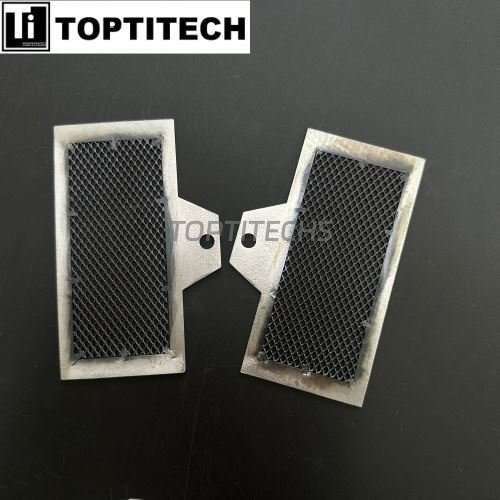
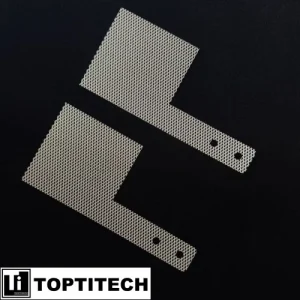
Platinized Titanium Expanded Mesh (1 µm, HT-PEMFC)
Platinized titanium expanded mesh with platinum coating for HT-PEMFC and electrochemistry. Low contact resistance, uniform coating, custom sizes.
Products Specifications
| Material | GR1 titanium |
| Pore size | 2*3mm |
| Thickness | 0.5mm |
| Size | 55*55mm |
| Coating | 1um Platinum coating |
Overview of Platinized Titanium Mesh for HT-PEMFC
The platinized titanium mesh HT-PEMFC is a specialized electrode substrate engineered for high-temperature proton exchange membrane fuel cells. Built on expanded titanium mesh and coated with a precisely controlled 1μm platinum layer, it delivers exceptional catalytic activity combined with long-term corrosion resistance. Unlike carbon-based gas diffusion layers that degrade under oxidative conditions, this all-metal electrode combines the mechanical strength of titanium with the electrochemical performance of platinum for reliable operation at temperatures exceeding 120°C. Typical applications include HT-PEMFC stack electrodes, electrolyzer current collectors, and electrochemical sensors. TOPTITECHS manufactures this product with tight dimensional tolerances and consistent coating uniformity.
Platinum Coating Process for Platinized Titanium Mesh HT-PEMFC
The 1μm platinum layer on the platinized titanium mesh HT-PEMFC is deposited through a controlled electroplating process ensuring uniform thickness, strong adhesion, and consistent electrochemical performance. Surface preparation begins with degreasing, acid etching, and activation to remove titanium oxide layers that could impair coating adhesion. Platinum electrodeposition follows under precisely regulated current density and bath chemistry to achieve a dense, pore-free deposit. Post-plating thermal treatment enhances the platinum-to-substrate bond, reducing delamination risk during thermal cycling. Coating thickness is verified through X-ray fluorescence (XRF) measurement on every production batch, ensuring integrity under the acidic, high-temperature conditions of HT-PEMFC operation.
HT-PEMFC Electrode Performance with Platinized Titanium Mesh
When deployed in HT-PEMFC stacks, the platinized titanium mesh HT-PEMFC delivers performance that directly improves fuel cell efficiency and power density. The expanded mesh geometry provides an open area exceeding 60%, facilitating unobstructed gas diffusion while minimizing mass transport losses at high current densities. The 1μm platinum coating offers a high electrochemically active surface area that accelerates the oxygen reduction reaction (ORR) and hydrogen oxidation reaction (HOR), reducing activation overpotentials. In single-cell testing at 160°C with phosphoric acid-doped PBI membranes, electrodes on this substrate demonstrate stable polarization with minimal voltage decay. The three-dimensional mesh structure enhances interfacial contact with the membrane electrode assembly, reducing contact resistance and ensuring uniform current distribution.
Catalytic Advantages of Platinized Titanium Mesh HT-PEMFC
The catalytic advantages of the platinized titanium mesh HT-PEMFC stem from the synergy between substrate design and coating quality. The expanded mesh maximizes geometric surface area for platinum deposition while maintaining structural openings for gas transport, decoupling catalytic and mass transport functions that compete in conventional porous electrodes. The continuous platinum layer ensures every exposed platinum atom participates electrochemically. The titanium substrate’s inherent resistance to phosphoric acid corrosion keeps the catalytic layer intact after thousands of hours, unlike carbon supports that suffer from corrosion and platinum agglomeration. This yields higher catalyst utilization efficiency, reducing platinum loading per kilowatt of fuel cell output.
Durability of Platinized Titanium Mesh HT-PEMFC
Long-term durability defines the platinized titanium mesh HT-PEMFC, suiting it for commercial fuel cell systems requiring extended maintenance intervals. The titanium substrate is immune to oxidative corrosion that plagues carbon-based gas diffusion layers at high potentials and temperatures, eliminating a primary HT-PEMFC electrode failure mode. The platinum layer, bonded through interdiffusion during heat treatment, resists dissolution and migration under potential cycling simulating start-stop and load-following operation. Accelerated stress testing at 1.2 V vs. RHE and 160°C demonstrates minimal surface area loss after 5,000 cycles. The all-metal construction withstands compressive forces during stack assembly without cracking, maintaining consistent contact pressure and electrical resistance.
Quality Control for Platinized Titanium Mesh HT-PEMFC
TOPTITECHS implements multi-stage quality control for every batch of platinized titanium mesh HT-PEMFC. Incoming expanded mesh is inspected for dimensional accuracy including strand width, strand thickness, LWD, and SWD using optical measurement. After coating, each sheet undergoes XRF thickness mapping at multiple points to verify the 1μm nominal thickness within ±0.1μm tolerance. Additional testing includes adhesion assessment via tape test per ASTM D3359, electrochemical active surface area measurement via cyclic voltammetry, and corrosion resistance verification through potentiostatic polarization in simulated HT-PEMFC electrolyte. Every shipment includes a certificate of conformance documenting all results, ensuring traceability from raw material to finished product.
Customization Options for Platinized Titanium Mesh HT-PEMFC
TOPTITECHS offers extensive customization for the platinized titanium mesh HT-PEMFC to meet diverse fuel cell designs and production requirements. Substrate parameters include mesh strand width (0.5mm to 2.0mm), strand thickness (0.1mm to 0.5mm), LWD and SWD dimensions, and sheet sizes up to 600mm × 600mm. Platinum coating thickness ranges from 0.5μm to 5μm to balance catalytic performance against material cost. Additional options include platinum-iridium alloys for enhanced oxygen evolution and platinum-ruthenium compositions for improved carbon monoxide tolerance in reformate-fed systems. Custom geometries including circular discs, rectangular strips, and tabbed electrodes are produced via precision cutting or stamping. Small-batch prototyping with rapid turnaround supports R&D electrode optimization. For related products, see our platinized titanium expanded mesh and the titanium expanded mesh substrate options.