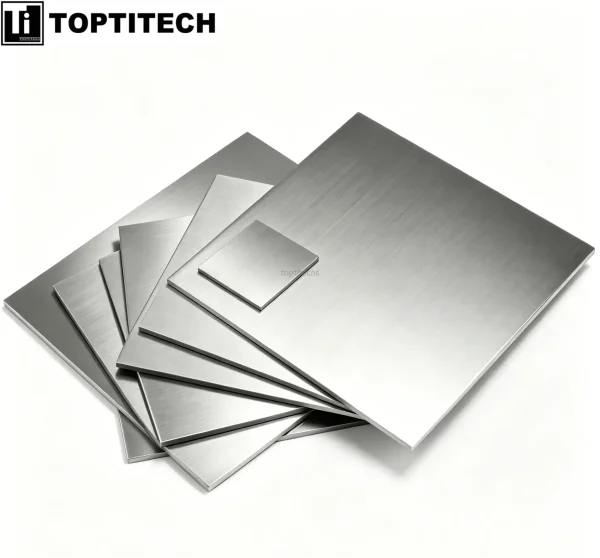
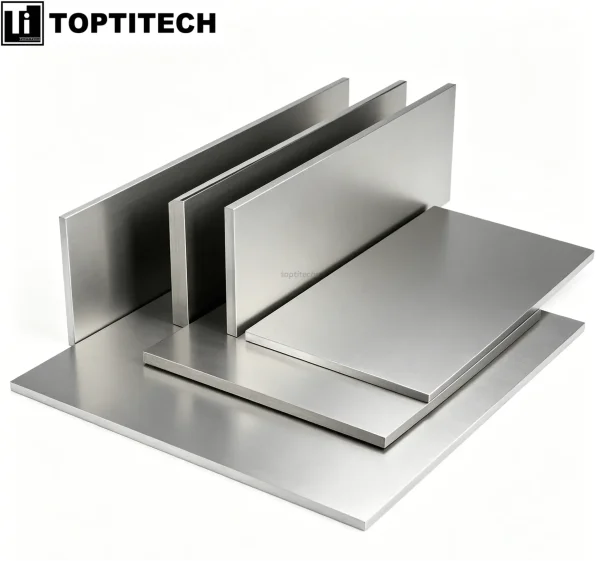
1 mm Titanium Sheet (Grade 1)
1 mm titanium sheet, Grade 1 (TA1), ASTM B265. Pure titanium plate with excellent weldability and corrosion resistance, custom sizes available.
Products Specifications
1.0mm Grade1/TA1 Pure Titanium Sheet
Overview
The 1.0mm Grade1/TA1 pure titanium sheet is a mainstream cold-rolled titanium plate that occupies the central position in the TA1 thin-sheet product family, balancing ultra-thin formability with sufficient structural stiffness for a broad class of industrial and engineered applications. Conforming to ASTM B265 and GB/T 3621-2007, the 1.0mm TA1 sheet is produced from commercially pure Grade 1 titanium (UNS R50250) with titanium purity above 99.5%. The standard supply form is a 1.0 mm × 1000 mm × 2000 mm bright-annealed sheet in the M (annealed) condition, available with cut-to-size or custom dimensions on request.
Grade 1 titanium at 1.0 mm delivers the highest elongation of any titanium grade — at least 30% — enabling complex cold forming, tight-radius bending, and deep drawing without the intermediate annealing cycles that thicker or higher-strength titanium grades require. Combined with outstanding resistance to seawater, chloride solutions, and organic acids, the 1.0mm TA1 sheet is widely adopted across marine engineering, chemical process equipment, food processing plant, and electrolytic cell construction.
Material Specification and Chemical Composition
| Element | Ti (base) | Fe | O | C | N | H | Other (total) |
|---|---|---|---|---|---|---|---|
| Requirement | ≥99.5% | ≤0.20% | ≤0.18% | ≤0.08% | ≤0.03% | ≤0.015% | ≤0.40% |
Standards: GB/T 3620.1-2007 (grade designation TA1), GB/T 3621-2007 (sheet and plate product), ASTM B265 (strip, sheet, and plate for Grade 1 / R50250). Default delivery condition: M (fully annealed), equiaxed alpha microstructure, no precipitation-hardening phases.
Physical and Mechanical Properties
| Property | Value |
|---|---|
| Density | 4.51 g/cm³ |
| Melting point | 1668 °C |
| Thermal conductivity | 17 W/(m·K) |
| Coefficient of thermal expansion | 8.6 × 10⁻⁶ /°C |
| Magnetic behaviour | Non-magnetic |
| Hardness | HV 120–150 / HB 60–70 |
| Tensile strength (Rm) | 240–340 MPa (min. 240 MPa) |
| 0.2% proof stress (Rp0.2) | ≥170 MPa |
| Elongation at fracture (δ₅) | ≥30% |
| Reduction of area | ≥35% |
| Impact toughness | 150–200 J/cm² (no embrittlement to −196 °C) |
| Fatigue limit (10⁷ cycles) | ~140 MPa |
Plate Specification Categories
| Category | Thickness Range | Surface Condition | Typical Uses |
|---|---|---|---|
| Cold-rolled sheet | 0.3–6.0 mm | Bright, high-precision | Sheet metal, stamping, decorative components |
| Medium plate | 6–25 mm | Bright or pickled | General structural parts, corrosion-resistant equipment shells |
| Hot-rolled heavy plate | 25–60 mm | Mill scale (requires pickling / machining) | Thick-wall structural fabrications |
Standard delivery condition: M (annealed). Hard (Y) and hot-rolled (R) conditions available on request.
Corrosion Resistance
The spontaneously regenerating TiO₂ passive film on Grade 1 titanium provides corrosion immunity across a wide range of aggressive environments encountered in marine and chemical service:
Excellent resistance: seawater and salt spray, chloride-bearing process streams, nitric acid, acetic acid, citric acid and food-grade organic acids, dilute alkali at ambient temperature, hydrogen peroxide, hypochlorite solutions, food and pharmaceutical contact media. Seawater corrosion rate below 0.001 mm/year, no pitting or crevice corrosion.
Incompatible media: hydrofluoric acid (HF), hot concentrated hydrochloric acid, dilute sulfuric acid, phosphoric acid, anhydrous dry chlorine, hot fuming nitric acid, molten strong alkalis.
Applications of 1.0mm TA1 Titanium Sheet
The 1.0mm thickness strikes the practical optimum between formability and rigidity, making it the dominant gauge for:
- Marine engineering components — seawater desalination plant liners, shipboard heat exchanger tubesheet blanks, coastal power station condensate piping, and offshore anti-corrosion structural facings exposed to continuous chloride environments.
- Chemical process equipment — reactor vessel liners, heat exchanger plate blanks, manifold sheets, and anti-corrosion wall cladding for pharmaceutical, fertiliser, and fine-chemical plant where resistance to halide and organic acid media is required.
- Food and beverage processing — tanks, conveyor components, hygienic fittings, and evaporator panels where non-toxicity, non-magnetic properties, and cleanability under CIP / SIP regimes are specified.
- Electrochemical equipment — anode current distributors, bipolar separator sheets, and electrolysis cell structural panels in chlor-alkali, water electrolysis, and electroplating applications.
- Sheet metal and precision fabrication — brackets, housings, enclosures, and formed sheet-metal assemblies for aerospace non-structural and high-end consumer electronics requiring low weight and corrosion immunity.
Fabrication Guidelines
Cold forming: Excellent — 90° bending, roll forming, and deep drawing without intermediate annealing. Single-pass cold deformation ≥40% achievable. Post-forming stress-relief anneal at 670–720 °C recommended for tight-tolerance assemblies.
Welding: Fully weldable by GTAW (TIG) using matching ER Ti-1 filler. Rigorous argon back-purging of weld root and surrounding heat-affected zone is essential to prevent embrittlement from oxygen or hydrogen contamination.
Machining: Use titanium-specific carbide tooling, low cutting speed, heavy feed rate, and generous coolant supply to prevent built-up edge and work-hardening on the finished surface.
Hot working: Processing temperature 800–900 °C under vacuum or argon atmosphere; mandatory inert gas protection to prevent high-temperature oxygen absorption and hydrogen embrittlement.
Annealing: 670–720 °C, 30–120 min soak, air cool, under vacuum or inert gas atmosphere to avoid surface oxidation.
Grade Selection: TA1 vs TA2
| Parameter | TA1 (Grade 1) — this product | TA2 (Grade 2) |
|---|---|---|
| Purity / impurity level | Higher purity, lower impurities | Slightly higher impurities |
| Tensile strength (Rm) | 240–340 MPa | 345–450 MPa |
| Elongation (δ₅) | ≥30% — best cold formability | ≥20% |
| Cold forming | Optimal — deep drawing, complex sheet metal, tight bends | Good — standard forming, moderate radii |
| Primary applications | Thin-plate deep drawing, medical implants, thin-walled desalination parts, precision non-magnetic components | General chemical equipment, load-bearing thick-plate structures, conventional corrosion-resistant shells |
| Cost | Slightly higher | More cost-effective |
Key Usage Precautions
- Fluorine-containing media: Prohibit prolonged contact with HF or any fluoride-bearing liquid; oxide film failure leads to rapid through-wall corrosion.
- High-temperature processing and welding: Must be performed under inert gas (argon) protection throughout; atmospheric oxygen or hydrogen causes embrittlement of the heat-affected zone.
- Large-deformation cold working: Intermediate annealing is required after heavy cold work to restore ductility and prevent workpiece cracking.
- Medical-grade hydrogen control: Hydrogen content must be strictly controlled to meet implant standards (ISO 5832-2 or equivalent); specify low-H lots when ordering for implant applications.
- Galvanic isolation: When assembling titanium sheet with carbon steel structural members, insulating gaskets or isolation tape must be fitted at all contact points to prevent galvanic corrosion of the steel.
Quality, Certification, and Customization
Mill test reports covering chemical analysis, tensile test results, and dimensional inspection accompany every shipment, with full traceability to the originating heat number. TOPTITECHS ISO 9001 certification supports customer quality management system requirements. Custom configurations available include non-standard sheet sizes, slit coil widths, tighter thickness tolerances, surface finish options (bright-annealed, polished, acid-pickled), and low-hydrogen controlled lots for medical applications. Browse the complete titanium sheets & plates range for other thicknesses and alloy grades.
Related Products
Related products
 Titanium Sheets & Plates
Titanium Flow Field Plate
- Titanium Sheets & Plates
5 mm Titanium Plate (Grade 1)
- Titanium Sheets & Plates
3 mm Titanium Sheet (Grade 1)
- Titanium Sheets & Plates
2.5 mm Titanium Sheet (Grade 1)